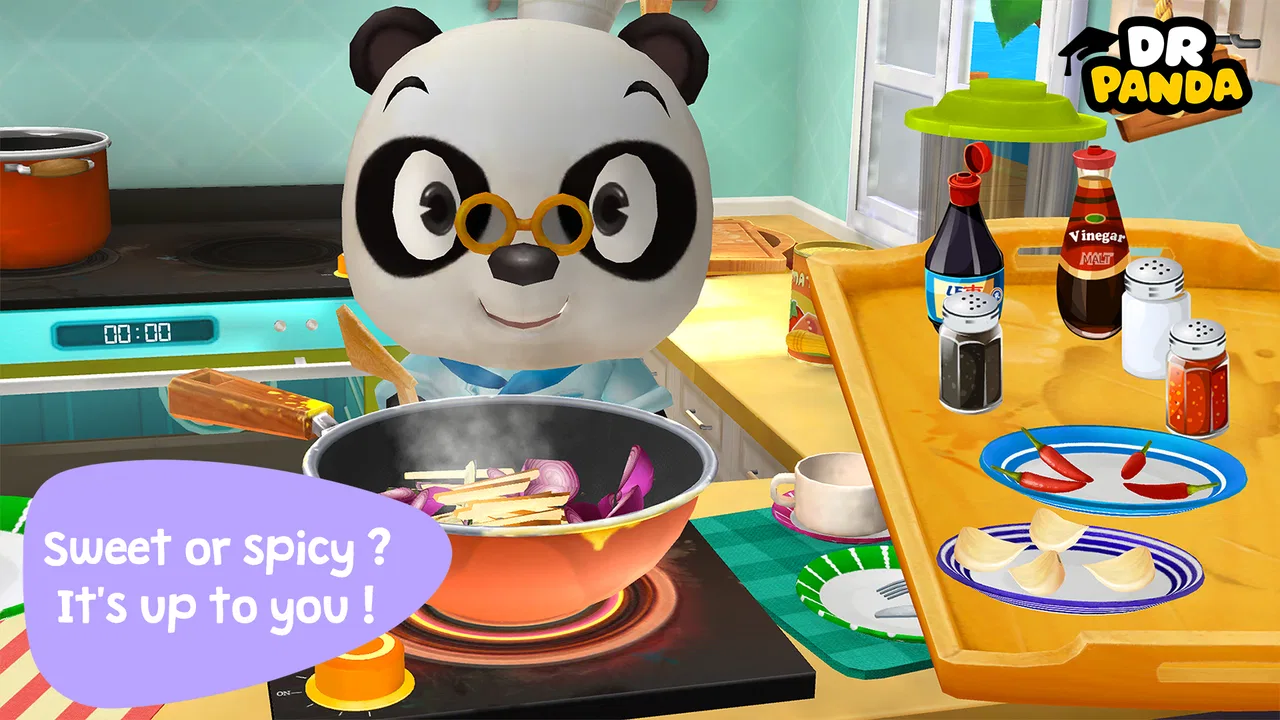
Dr. Panda Restaurant 2
- 4.1
- Rating
- 100.00K
- Installs
- $3.99
- Price

 Analysis by App-foxy
Dr. Panda Restaurant 2 is the kind of children’s game I can imagine opening during a quiet afternoon when a child wants to do something independently, but still needs an activity that is easy to understand. Instead of asking the player to follow a long lesson or manage complicated menus, it puts them in charge of a playful restaurant kitchen. I found the appeal strongest in the simple feeling of choosing what to prepare, handling ingredients, and seeing the meal come together.
That simplicity is important. This is an educational game from Dr. Panda, designed for Everyone, and it works best when the child is allowed to explore rather than being pushed toward a strict score. The store summary says kids can take charge in their own kitchen, and that is a fair description of the central idea without capturing why the game can hold attention: the player is not just watching an animation. They are making small decisions and seeing immediate results.
My overall impression is that this is a gentle kitchen playground with light progression, not a demanding restaurant-management simulation. Families looking for calm, hands-on play will probably appreciate that distinction. Children expecting constant challenges, competitive leaderboards, or a deep cooking system may find it too relaxed. I would recommend it to parents who want a focused, age-appropriate activity, especially for younger players who enjoy pretend play and cause-and-effect interactions.
You May Also Like

 Pandora - Music & Podcasts
Pandora’s Music Is Easy to Start, but Harder to Recover
Pandora’s strength is its low-effort path from a seed to a station. Its weak spot is how much confidence it asks you to place in connection, setup, and quiet recovery.

 8 Ball Pool
 Is Built on Rivalries, Rematches, and Routine
A close look at the rivalries, rematches, shared routines, and unanswered safety questions that turn a quick pool match into a persistent mobile community.

 Samsung Music
’s Quiet Strength Is Playing What You Already Own
Its reach comes less from spectacle than from dependable access to a personal library. That simplicity is both the app’s strongest retention engine and its ceiling.

 AccuWeather: Weather Radar
AccuWeather Review: A Quick, Clear Forecast for Everyday Decisions
For everyday plans, the best forecast is the one you can understand quickly. AccuWeather makes rain timing, radar, and local conditions easy to act on, with a few trade-offs.

 Hill Climb Racing
Why Hill Climb Racing Still Turns Crashes Into One More Run
A tiny car, a bumpy hill and one more upgrade: Hill Climb Racing keeps resurfacing because its simple chaos makes every near-miss feel personal.

 AliExpress - Shopping App
AliExpress Makes Global Shopping Feel Personal, but Shoppers Bear the Risk
AliExpress turns a global marketplace into a pocket-sized discovery engine. Its reach is useful, its shopping loop compelling, and its trade-offs easy to miss.
More From Our News Desk
View All News


How the first kitchen sessions feel
The opening experience is easy to approach because the basic goal is obvious: prepare food for restaurant visitors. A child does not need to understand complicated rules before beginning. The kitchen itself provides the context, while the ingredients and cooking actions give the player something concrete to do. In my experience, that makes the first session feel more like guided pretend play than a traditional game tutorial.
The early goals are modest, but they are useful. A child can concentrate on selecting ingredients, carrying out kitchen actions, and completing a dish rather than worrying about a large map or a long chain of instructions. Each small task creates a clear reason to continue. When a meal is finished, the result gives the player a satisfying signal that their choices mattered.
This is also where the educational value becomes more practical than academic. The game encourages sequencing: choose something, prepare it, cook or combine it, and serve the result. It can support conversations about food, kitchen routines, and what happens when ingredients are handled in different ways. I would not treat it as a replacement for structured learning, but it can turn ordinary curiosity about cooking into a safe digital activity.
One useful way to introduce it is to sit with a child for the first few sessions and ask them to explain their choices. Rather than taking over, I would ask questions such as what they want to make, which ingredient should come first, or what they think a customer might enjoy. That approach makes the game more interactive between parent and child and helps reveal whether the player enjoys experimentation or prefers clear direction.
Small choices are the real early reward
The strongest early motivation does not come from a complicated achievement system. It comes from the freedom to try something and immediately see the kitchen respond. Children who like arranging, combining, and pretending to run a restaurant have a natural reason to repeat the process. The game gives their imagination a setting and a sequence of actions.
That freedom also means the experience can feel different from one child to another. One player may focus on making familiar meals, while another may be more interested in unusual combinations or simply repeating the most entertaining kitchen actions. I see that flexibility as a strength for open-ended play, although it can be less satisfying for a child who wants a clearly defined mission at every moment.
A realistic everyday use case would be a short session before dinner. A child can play restaurant while an adult prepares the family meal, then talk about the ingredients used in both kitchens. It is not a substitute for helping with real food, of course, but it can give a younger child a way to participate in the idea of cooking before they are ready to handle actual utensils or heat.
What counts as progress
Progress in this game is felt through growing familiarity and the player’s ability to make more confident choices. The child learns where actions happen, how an ingredient behaves, and what sequence produces a satisfying result. Those are meaningful progress signals for a young audience, even when they are less formal than levels, ranks, or numerical scores.
I think parents should set expectations accordingly. The game is not built around the kind of visible advancement found in a large adventure game. A child may not always receive a dramatic reward after every action. Instead, the sense of improvement comes from understanding the kitchen better and becoming more independent within it. For some children, that is enough. For others, the lack of a strong reward ladder may reduce interest after the novelty fades.
There is a subtle advantage to this approach: it keeps the focus on the activity rather than on chasing a perfect result. A child can experiment without feeling that every mistake ruins a run. That makes it easier to encourage curiosity. I would especially value this for children who become frustrated by timed games or who are still developing confidence with interactive controls.
At the same time, the relaxed structure can make the game feel less purposeful to adults who expect educational software to announce what skill is being practiced. The learning is embedded in the play, not presented as a lesson plan. If you want explicit spelling, arithmetic, reading, or science exercises, this is not the right category of tool. Its educational angle is practical decision-making and imaginative kitchen play.
How the difficulty curve supports younger players
The difficulty curve is gentle because the game’s central actions are approachable. That is a good match for its Everyone age rating and for children who may not have much experience with game controls. The player can focus on understanding the kitchen without being overwhelmed by fast reactions or complicated resource management.
For a younger child, this pacing can feel reassuring. They have time to observe what is happening and try again when a choice does not produce the result they expected. I prefer that kind of low-pressure learning in a game aimed at children. It gives the adult a chance to let the child lead instead of constantly correcting them.
The trade-off is that experienced young players may move through the initial discovery period quickly. A child who already understands touch controls and enjoys challenge may want more demanding goals than the game provides. I would not choose it as a primary game for a player who asks for difficult puzzles, strict time limits, or a strong sense of mastery.
Another point worth considering is attention span. The calm pacing makes it suitable for short visits, but it does not guarantee long sessions. In my view, that is not necessarily a weakness. A game for children does not need to keep them occupied for an hour to be useful. A focused period of imaginative play can be a better outcome than endless engagement, particularly when the child can stop without losing complicated progress.
Where the retention comes from
The game’s ability to bring a child back depends mainly on experimentation and pretend play. The kitchen provides a familiar role, and the player can return to it to try another preparation or revisit actions they enjoyed. That is a softer form of retention than daily rewards or competitive events, and it avoids putting pressure on the child to return at a specific time.
I see this as a healthy fit for families that want a game to remain available without turning it into a routine obligation. There is no need to frame every session as a target to complete. A child can play for a few minutes, leave, and come back later with the same basic understanding. That makes it easy to include alongside drawing, books, toys, or real-world cooking activities.
Still, the same quality can limit long-term replay for children who need constant novelty. If a player has already explored the kitchen’s main possibilities and does not enjoy repeating familiar actions, the motivation may weaken. Parents should think of it as a reusable creative activity rather than a content-heavy game that continually introduces new worlds or complex systems.
One practical tip is to vary the way you use it. Instead of asking a child simply to play, suggest a small theme: prepare something for a pretend breakfast, create a meal using a particular color, or explain the order of the kitchen steps. These prompts do not change the game itself, but they can give each session a fresh purpose and encourage communication without turning play into a test.
What it does better than usual alternatives
Compared with a standard educational quiz, this game gives the child more room to act. A quiz usually asks for a correct answer, while the restaurant setting lets the player explore a process. That makes it a better choice for children who learn through doing and pretending rather than selecting answers from a list.
Compared with a realistic cooking simulator, it is much easier to approach. A detailed simulator may offer more rules, measurements, and consequences, but those systems can distract a younger player from the basic pleasure of preparing food. Dr. Panda Restaurant 2 keeps the fantasy of running a kitchen at the center, which is more suitable for a child who wants immediate interaction.
Compared with an open-ended digital toy, it has a clearer setting and purpose. The restaurant gives the play a beginning, middle, and result: decide what to prepare, work through the kitchen, and serve the meal. That structure can help a child who enjoys freedom but still benefits from a recognizable activity.
The compromise is depth. Adults looking for a serious cooking lesson, a detailed management game, or measurable academic practice will find better options elsewhere. This title succeeds when the goal is to make kitchen-themed play approachable, not when the goal is to simulate every part of restaurant work.
Useful details for parents before installing
The game costs $3.99, so I would approach it as a paid children’s activity rather than a free trial that happens to include a kitchen theme. That price makes the decision more personal: it is worth considering whether the child already enjoys cooking pretend play, ingredient-based games, or creative touch activities. If those interests are present, the focused design is more likely to feel worthwhile.
It has an average rating of 4.1 from around 3.9 thousand ratings, with roughly 270 written reviews, and it has passed 100 thousand installs. Those figures suggest a real audience, but they should not replace thinking about your child’s play style. A popular game can still be a poor match for a child who needs stronger challenge or more explicit learning tasks.
On Android, the listed minimum requirement is version 6.0, and the current version is 26.3.55. I would check the device before purchasing, especially if the game is intended for an older tablet that has not been updated recently. The developer is Dr. Panda, a name associated here with a child-focused approach, and the Everyone content rating makes the intended audience clear.
Another question parents often have is whether a child can use the game without constant adult instruction. I found the central idea straightforward enough for independent exploration once the child understands the basic kitchen flow. Younger players may still benefit from an adult nearby at first, not because the concept is difficult, but because talking through choices adds value and helps them discover more than simply repeating one familiar action.
It is also worth asking whether this is suitable for a child who dislikes mistakes. The relaxed design should be more forgiving than a timed challenge game, but every child responds differently to unexpected results. I would demonstrate that experimentation is the point and avoid judging the meals. If the child becomes bored without clear wins, a more structured educational game may be a better fit.
Who should choose it, and who should skip it
I would choose this for a young child who enjoys pretend restaurants, toy kitchens, selecting ingredients, and seeing a process unfold. It is particularly appealing when you want screen time to involve imagination and simple decision-making rather than passive video watching. It can also work well as a shared activity between siblings or an adult and child, provided everyone allows the youngest player to make the decisions.
I would be more cautious for a child who wants a strong challenge curve. If the main attraction is beating a timer, earning high scores, unlocking complex equipment, or managing a busy restaurant, this game may feel too light. The same applies to families seeking a formal curriculum. Its educational benefit comes from interactive role-play, not from explicit academic instruction.
For adults, the most important trade-off is between calm freedom and sustained structure. The first quality makes the game welcoming and low pressure. The second is limited, so the experience may not hold attention indefinitely for every player. I see that as a reason to keep it in a small collection of activities, not necessarily as the only game on a child’s device.
My verdict on its progression and pacing
Dr. Panda Restaurant 2 handles early goals well because it gives children an immediately understandable role: they are in charge of a playful kitchen. Its progress signals are mostly experiential, built around learning the actions and becoming more confident. The difficulty stays gentle, which supports independent discovery but leaves less room for children who want demanding mastery.
Its retention is based on returning to familiar creative play rather than pressure-heavy reward loops. That makes it easy to recommend for short, relaxed sessions, especially when an adult wants an activity that can be discussed and extended with real-world ideas. The downside is that children who need frequent unlocks or increasingly complex challenges may run out of reasons to continue sooner than expected.
After trying to judge it as both an educational game and a children’s play space, I think its best identity is the second one with a useful learning layer. It does not need complicated systems to achieve that. The kitchen gives children a safe place to make choices, follow a sequence, and enjoy the result. If your child values imagination more than competition, this is a friendly and focused purchase; if they need deep progression, look for a more demanding alternative.
FAQs for Dr. Panda Restaurant 2
01What is Dr. Panda Restaurant 2?
Dr. Panda Restaurant 2 is a child-friendly cooking and restaurant simulation game for Android and iOS. Players prepare meals, serve animal customers, and explore a colorful kitchen filled with interactive ingredients and utensils. The game is designed around open-ended play rather than strict objectives, allowing children to experiment with recipes and create their own restaurant stories at their own pace.
02Is Dr. Panda Restaurant 2 suitable for children?
Yes, the game is primarily designed for young children and uses simple touch controls, bright visuals, and gentle gameplay. There are no complicated menus or difficult challenges to master. Children can tap, drag, cut, mix, cook, and serve food independently. Parents should still review the current store listing and device settings, especially regarding optional purchases, advertising, and privacy permissions.
03Does Dr. Panda Restaurant 2 require an internet connection?
The core cooking and restaurant activities can generally be enjoyed offline after the game has been installed, which makes it convenient for travel or play without mobile data. However, internet access may be needed for downloading the application, checking updates, restoring purchases, or accessing certain store-related features. Availability can vary by platform version, so confirm the latest requirements before downloading.
04Does Dr. Panda Restaurant 2 contain ads or in-app purchases?
The presence of advertisements, paid content, or purchase options may depend on the version and platform from which the game is downloaded. Dr. Panda titles are commonly offered as paid or family-oriented experiences, but store policies and editions can change. Parents should check the official Google Play or App Store page for the exact price, in-app purchase details, and advertising information before installation.
05What can children do inside Dr. Panda Restaurant 2?
Children can interact with a variety of kitchen tools and ingredients while preparing food for animal guests. They may chop, stir, fry, bake, combine ingredients, and deliver meals, with plenty of room for imaginative experimentation. The game does not focus heavily on scores or time limits, so it encourages creativity, coordination, and pretend play instead of competitive performance.
Pros
- Simple controls make it easy for young children to play independently.
- Bright animations and playful characters keep the restaurant setting engaging.
- Open-ended activities encourage creativity instead of strict win-or-lose goals.
- Different ingredients and cooking tools provide varied role-play options.
- The game can be enjoyable for siblings or parents playing together.
Cons
- Gameplay may feel repetitive after children explore the available restaurant tasks.
- Some children may find the lack of clear objectives less motivating.
- The app offers limited challenge for older kids or experienced players.
- Device storage and performance requirements may vary across older phones.
- Parents should review in-app settings and purchases before handing over the device.

Dr. Panda Restaurant 2
Gallery